Extracts from "Shipwrecks" by Maureen Attwooll
(published by kind permission of The Dovecote Press)
Dorset's coast is notorious for the number of ships (more than 1,000 vessels) which have been wrecked along its length. Vessels of every description have foundered on the rocks, ledges, beaches and bays that lie between Poole Harbour and Lyme Regis - victims of storm, fog, fire, human error and war. The waters off the Isle of Purbeck, Portland and Chesil Beach are perhaps the most crowded graveyards in the Channel. Tragedy and heroism call the roll on tales of wrecks that embrace looting, the "Great Gales" of 1824 and 1838, the arrival of steamships and submarines, and the two World Wars of the twentieth century.
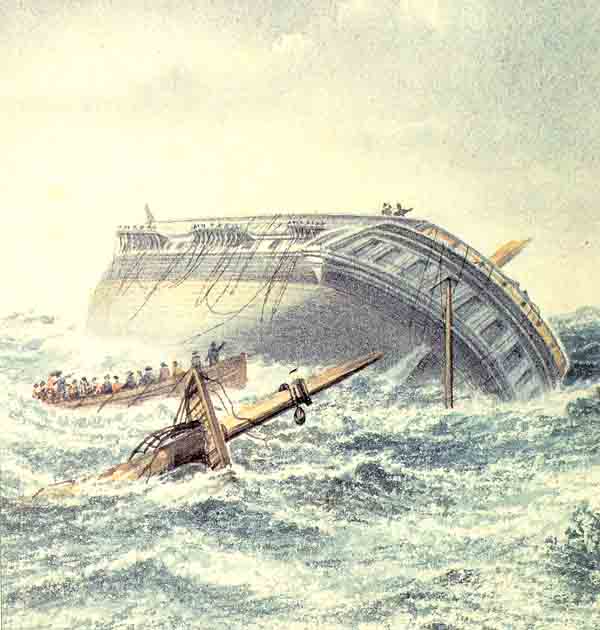
The wreck of the "Heroine", Lyme Regis 1852 - Watercolour by William Bennett
The Great Gales of 1824 and 1838
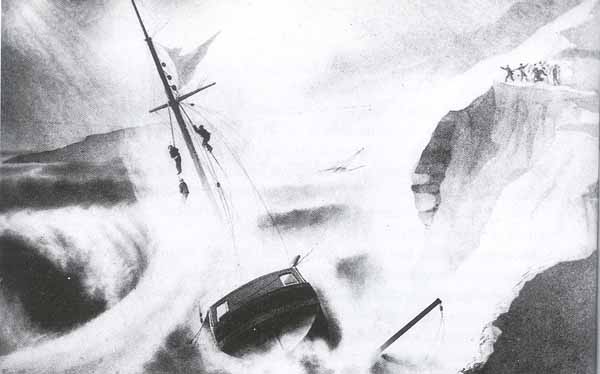
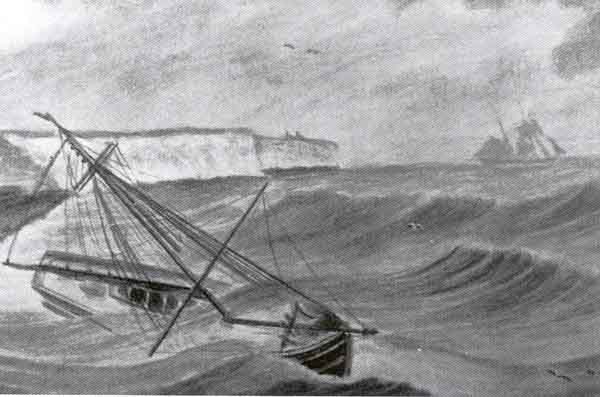
The night of 22nd/23rd November, 1824 produced a 'terrifying storm' that hit the whole of south-west England leaving a trail of devastation in its wake. At Portland, giant seas swept over Chesil Beach and crashed down on the village of Chesil, demolishing more than 30 houses and so damaging a hundred others that they were uninhabitable. Twenty five Portlanders drowned in the deluge, some buried under their homes, others swept away by the sea. In the days that followed it was not only the dead that the islanders were burying; each tide threw up on the beach the bodies of those lost at sea. Picture above: The wreck of the Unity at Lyme Regis. '...the mothers, wives, sisters and friends of the crew joined in the general rush towards the Church Cliffs, crying and screaming in agonies to see the poor fellows in the shrouds'. All the crew were saved. On Wednesday, 28th November, 1838 another major storm took place and 24 hours later wrecked vessels were scattered all along the Dorset coast. Picture below: Lost on Chesil Beach in the 1838 gales was 'the sloop Dove of Weymouth, Captain Bussell, happily all hands were saved, and also part of the cargo'.
|
 |
 |
|
Wartime wrecks.If gales had not ended their journey first, Dorset's earliest known shipwrecks - a fleet of Danish galleys wrecked off Perveril Point in 877 - could well have been casualties of war. The Danes had left Wareham, to relieve their countrymen besieged at Exeter by King Alfred's forces, but storms drove 120 of the Danish vessels on shore before English war galleys had the chance to intercept them. Another famous sea fight which resulted in the loss of warships off the Dorset coast took place in the seventeenth century. During the Battle of Portland in 1653, the 32-gun Sampson and several Dutch ships were sunk before the English under Blake chased Admiral Van Tromp's Dutch fleet up the channel to eventual defeat. But it is the two World Wars of the twentieth century which account for the vast tonnage of vessels and hundreds of lost lives which now lie at the bottom of the English Channel. More than 150 ships are known to have been torpedoed, mined or bombed off Dorset in the wars of 1914-1918 and 1939-1945 and the casualty lists are not complete. At the time, these shipwrecks rarely made the news due to wartime press restrictions, and a fear that reporting their loss might prove useful to the enemy. (see "Vessels sunk by enemy action" for a list of known sinkings) As can be seen from the list, not a month passed without British shipping being lost off Dorset due to U-boat activity. However, not every German submarine survived and between Portland and Start Point, U-85, UB-19, UB-72, UB-74, UC-51 and UC-62 were sunk. The area's last British casualties of World War I were two merchant steamships attacked on successive days in September 1918. On the 14th the Gibel Hamam was torpedoed by UB-103 off Abbotsbury with the loss of twenty-one of her crew. The Ethel fell victim to UB-104 a little farther to the west and sank while under tow for Portland. World War II had seen the appearance in Dorset of vast numbers of Landing Craft as LCT's and LCI's (Tank and Infantry Landing Craft) began assembling for the invasion force. These were the vessels which played a leading role in the D-Day landings of June 1944 and they were designed with bow doors and ramps which slammed down on the beaches to enable men and machines to storm ashore. Practice had to make perfect. The Dorset/Devon coast became a backdrop to endless rehearsals for the real thing - one of which was to have tragic consequences. A convoy of LC's heavily laden with American troops and vehicles was out in the channel during Exercise Tiger in April 1944. When 12 miles off Portland they were torpedoed by German E-Boats, prowling the area in search of Allied shipping. Two craft, LST's 507 and 531 were sunk, and the sea was soon littered with the bodies of the US servicemen who had been on board. It was a disaster which cost more than 500 lives. '....the last vessel being lost off Dorset in February that year (1945) was the steamship Everleigh, torpedoed by U-1017 and sunk with the loss of six of her crew.'
|
|
|
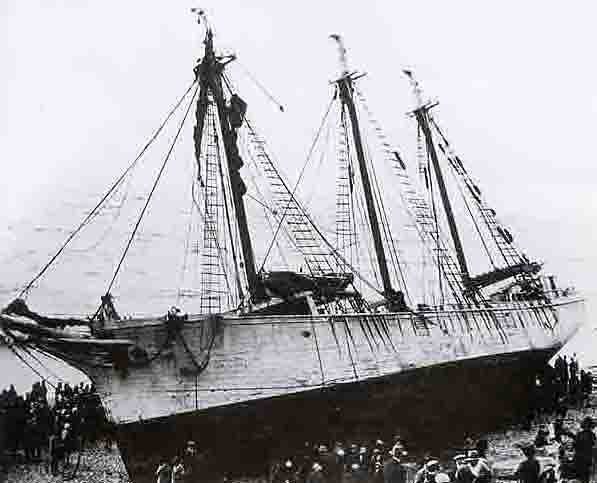
The last of the big sailing ships lost on the Dorset Coast was the French vessel Madelaine Tristan, wrecked at Portland in September 1930. The Madelaine Tristan remained beached in the Cove for five years after she was wrecked. 'She was', recalled a local fisherman, 'the finest prettiest sailing ship ever to come ashore on these coasts'. |
 |