Index Page of Various Articles On Local Shipwrecks
Extracts from the book "Shipwrecks" by Maureen Attwooll (includes wartime sinkings - see also below) - Ken Pett
Historical list of shipwrecks on Chesil Beach since 1600 - Ken Pett
Other Wrecks off Burton Beach - Ray West
The Mystery of the Sailors' war graves in Burton Bradstock cemetery - Ray West
The sinking of HMS Formidable - Ken Pett
The Wreck 'Flirt' a story of tragedy & local heroism - Ray West
Vessels sunk by enemy action - Ken Pett
Fascinating slide presentation by Gordon Le Pard on the history of shipwrecks in Dorset - Ken Pett/Jon Rayner
Introduction - Shipwrecks off Burton Bradstock
This article was specially written for our web site by Gordon Le Pard. ( www.dorsetcoast.com)
To the people who lived along the Dorset coast, not so many years ago, a shipwreck was seen as both an opportunity and a tragedy. To many of the local people, wrecks were a wonderful opportunity for loot. Whilst there is no evidence of deliberately encouraging shipwrecks (people prosecuted for showing lights on the beach were guiding smugglers, not wrecking ships) a 'good' wreck was something to be welcomed. A local saying, almost a prayer, ran;
Blow wind, rise storm
Ship ashore, before morn
Looting from wrecks was very profitable as Chesil beach, which runs south east from Burton is one of the most dangerous stretches of coastline in Britain. From Bridport to Portland, a distance of only 16 miles, over two hundred ships are known to have sunk and the actual total is certainly much higher. Stories abound of the looting and the horror of these wrecks. In 1749 the Hope, a Dutch vessel, ran onto Chesil Beach. Soon the story spread that she was carrying £50,000 in gold. A mob of ten thousand people gathered on the beach to loot the remains, and finally had to be dispersed by the army. In 1795 a fleet carrying a regiment to the West Indies was wrecked on the beach opposite Fleet House (now Moonfleet Manor Hotel), over three hundred bodies were subsequently buried in a mass grave on the beach. Most of them had been stripped naked by the local people. A hundred years later, on a freezing night in November 1872 the Royal Adelaide was wrecked at the Portland end of the beach, the cargo included brandy and rum. Some looters drank themselves insensible, and froze to death. Nearly as many people died of exposure as drowned in the shipwreck.
On the other hand wrecks could sometimes bring out the best in people, in November 1824 a terrible storm hit the Dorset coast. In the days that followed the vicar of Abbotsbury found and buried 18 sailors washed up on the beach. He was so shocked by the event that he decided to devote all his energies to preventing such dreadful things happening again and so the first lifeboats came to Dorset.
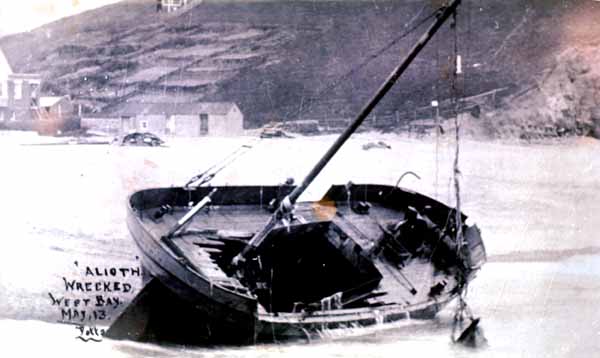
Very occasionally a wreck can even raise a smile. Such is the case of the Alioth at West bay. In May 1923 the German Ketch Alioth was preparing to leave Bridport harbour, a strong south west wind was blowing across the harbour entrance and the captain was advised to get a tow from the steam tug, and only set sail when he was well offshore. The tow would have cost 10 shillings. The captain refused and as soon as the Alioth left the harbour it was swept back on the beach and became a total wreck. No one was killed, but one wonders what the captain said to the ships owners!
Off Burton Bradstock there have been several notable shipwrecks, in January 1629 or 30 a Spanish ship came ashore, it was extensively looted. Remains of this shipwreck may have been found off Hive beach where several iron cannon have been discovered, some have been lifted and are in the museum at West Bay. On 23 November 1837 a Swedish Brig, the Systrarne was wrecked under Burton Cliffs, several men were saved and the vicar noted with pleasure how his parishioners had exerted themselves in descending the cliffs with ropes to save the unfortunate sailors, rather than just loot the wreck.
There have been many fascinating discoveries from shipwrecks off the coast, one of the strangest was found off West Bay in the summer of 2000, part of an elephants tusk! At first such a find may seem to have little to do with Dorset, but three hundred years ago ships were regularly sailing from Dorset to the African coast, coming back laden with tropical woods, ivory and gold dust. It must have been dreadful for the sailors, returning from a year long voyage to one of the most fever ridden parts of the world, only to sink within sight of home.
For it must never be forgotten that whilst wrecks are fascinating things to dive on and study, they have frequently been the scenes of disaster and tragedy.
See book entitled "Shipwrecks" in Dorset in the Books & Publications section