A Brief Guide to the history of St. Mary’s Church, Burton Bradstock
Introduction
St. Mary’s is the largest of eight churches in the Bride Valley, the others being at Shipton Gorge, Litton Cheney, Long Bredy, Puncknowle, Swyre and Littlebredy. There is a daughter church at Chilcombe, which has no known dedication.
The Church - General Appearance
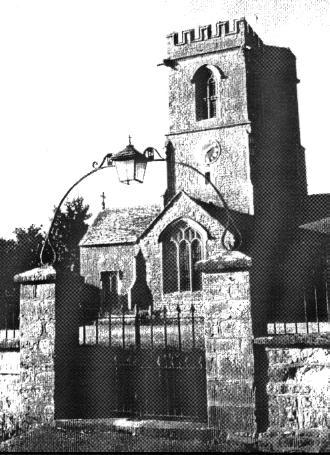
St. Mary's Church stands on slightly raised ground near the centre of the village. It is a handsome, good sized building of cruciform design with a central tower, which until last century was adorned with pinnacles. Like most of the houses in the village, it is built of local rubble stone (Inferior Oolite and Forest Marble), probably from the quarries at Bothenhampton, and is for the most part roofed with Delabole slates from Cornwall. Externally the church presents a pretty uniform appearance, but it is worth a walk around to look at the head stops and gargoyles, some of which are original, though a lot of repair work has been carried out to both windows and mouldings. It is interesting to note the round headed arches over the windows in the north wall of the chancel. These are relieving arches to take the strain of the weight on the square headed windows and could be contemporary with the wall, i.e. early 16th century, but on the other hand the regular appearance of the stones leads one to consider whether perhaps the top of this wall was refaced in the 19th century.
Some memorial stones are built into the external wall of the south aisle, and if you search long enough you will find the "false teeth" there too.
The church yard was cleared and levelled about 1949, leaving only the table tombs and one or two others.
On entering, one finds a place of light, for our church has very little stained glass, and was fortunate that the inevitable Victorian restoration was sympathetically carried out by E. S. Prior, and the windows are for the most part glazed with "Prior's Glass". This is a place which has been evolving through some nine centuries to become the building we know today.
It is probable that there has been a church on this site from early times, and the rebuilding which has taken place through the centuries is thought to be on 12th century foundations, though the nave and chancel have in all probability both been lengthened. However, the original cruciform plan is maintained, with noticeable misalignment of the east end, a pattern which is considered by some to be symbolic of the drooping head of Christ on the cross. This irregular plan could in fact, represent the church known to have existed here at the time of the Domesday Survey in 1086.
12th Century
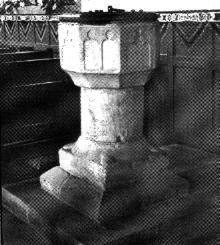
Nothing visible remains of the 12th century church today except the circular stem of the font, and the base, which is square moulded with spur ornament. No major development took place until the 14th century, but there is a recut and reset piscina in the chancel,and three stone coffin lids, which have been dated 13th/14th century.
14th Century
In the 14th century then, the nave was rebuilt and probably lengthened, as previously mentioned. The original square headed windows remain, though they have been restored in the 20th Century. So this wall, the oldest part of our church, has stood for 600 years.
Contemporary with the north wall is the elliptical recess with decorated ogee head, and cusp points carved with lions' heads and angels, now containing the pulpit. Its purpose remains obscure, but because of its siting at the foot of the Rood Screen it could well have been used during Lent for a portable (wooden) Easter Sepulchre.
From this period there also remain a few decorated encaustic tiles under the eastern arch of the crossing.
| The octagonal bowl of the font belongs to the 14th century too. It is decorated with alternate single and double trefoil and cinquefoil sunken panels. |
 |
15th Century
The early 15th century saw the rebuilding of the transepts and crossing, incorporating a central tower 64 feet high (19.45 m). It is of two stages, with external staircase and access to a rood loft. The transepts have diagonal buttresses, and follow the plan of the original church. They were not extended. Each has a large three-light pointed arched window, and their original barrel vaulted roof with embattled wall plates resting on stone corbelling, and divided into panels by moulded ribs with carved bosses at the intersections.
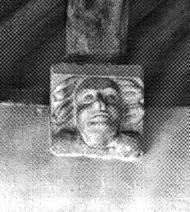
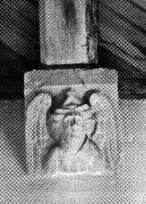
Other features also remain in the transepts. A pillar piscina with canopy in the north transept, indicative of there being an altar here, while in the south transept only the canopy of a piscina remains. There is also an image bracket in the north jamb of the chancel arch (the statue of the Virgin and Child within are modern - 1950 - and are carved by S. R. Cameron). Look up in the crossing and see that this ceiling is supported on stone corbels carved with heads and demi angels. Whether they are contemporary with the building of the tower, however, or perhaps reused carvings from the earlier church, must remain debatable. See also that the crossing itself is formed of four graceful panelled arches, surely one of the most pleasing features of our church. These are early examples of their kind, which remained fashionable in these parts throughout the century. On the stonework of these arches are a considerable number of Mason's Marks, some of which are easily discernible.
 |
 |
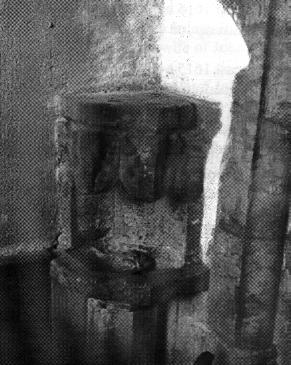 |
Church interiors at this time were highly decorated and colourful, before all such things were swept away by the Puritans, and on the west face of the south western pier of the crossing arches a very small and indistinct amount of original colour can just be seen.
The tower above has small diagonal buttresses above roof level, and an embattled parapet, which was adorned with pinnacles until they became unsafe and were removed in the 19th century. The staircase at the south-west corner, formerly had an external door on the south side, is square in section and is so positioned as to give access to the rood loft through a door which still remains and can be clearly seen. Above is the ringing chamber, and the belfry with a ring of 6 bells. (see later note).
At the same time as the aforesaid rebuilding, the nave roof was also renewed, possibly at a higher level. This again is a typical wagon roof, characteristic of the south-west. In this case, however, the plaster panels of the barrel vault have been replaced with boarding.
While all this was going on the west doorway and window were inserted (or renewed) and a north door and porch were built, incorporating a holy water stoup, and niches for statues within the porch and outside over the entrance. In the chancel can be seen 2 prayer desks constructed from seven late 15th century carved wooden panels of foreign provenance, together with some 17th century panelling. These carved panels may have been part of a chest.
16th Century
In the 16th century another rebuilding took place; that of the chancel. For the most part it stands on the original 12th century foundations, though it was very probably lengthened, and can be seen to be considerably out of alignment with the rest of the building. The windows in the north wall are square headed, one with glazed spandrels and the other blank. Between the windows is a doorway of the same period. The south wall appears to have had only one window, which has been blocked, although the recess remains. At the western end of the south wall near the chancel arch there can be seen a small recess with a lintel which could have been a hagioscope, giving sight of the altar from the south transept.
The small single light window high up in the north wall of the nave was probably inserted now, to give light to the rood screen. Externally it is charmingly decorated with two star-like symbols.
17th Century
During the years of the Civil War and the Commonwealth very little church building or reconstruction took place. Certainly there was none in our church, indeed, all had been rebuilt by then. Only two items date from the 17th century. The timber battened north door, which post-dates the restoration of Charles 11 by 21 years (the date 1681 can just be discerned), and the communion rails which, though Jacobean in design, have the date 1686 carved on them, along with the churchwarden's initials TB ID CW.
18th Century
From the 18th century, however, we have five panels with painted inscriptions, four of which originally formed a reredos, the fifth being a charity record to Matthew Darby, dated 1784. The decalogue (2 panels), Lord's Prayer and Creed have since been found homes on the walls in various parts of the church.
The tower clock, dating from 1788, was made by Aynsth Thwaites (previously thought to be Hyasrth Hurdiles) of London and came from Christ's Hospital when the school moved from London to Horsham in 1902. The clock was purchased by the rector of Burton Bradstock with the thought that it would be a fitting memorial to the late Queen, his outlay of £70 for transport and installation being subsequently reimbursed by subscription, the proceeds of fund raising events, and the sale of the original bell on which the hours had been struck for over 100 years. (see also here)
The setting dial inscriptions are:
Bottom of dial:
Aynsth Thwaites
LONDON
1788
Top of dial (more faded):
Altered to strike the Quarters
BY THWAITES & REED 1819
The significance is that this clock was invoiced in February 1788 and was the last bearing the name of Aynsworth Thwaites alone. From this date, clocks are signed by Aynsworth and John. So it has helped up pinpoint the change to within a few months. The Thwaites daybook entry for the Christ Hospital clock, dated 20 February 1788, reads:
a New Eight day Turret Clock to shew one Outside Diall Hours & Minutes the Great Wheels 14 Inches Diamiter & to Strike the Hours on a Bell of three Hundred three Quarters Weight all Properly Fixed over the Writing School at Christs Hospital ---
a New Copper Diall Plate of 5F:6in Diamiter with a Hammer'd Moulding round the edge & Painted Black with Gold Figures & the Moulding Gilt ---
a New Bell of 3:2:20 Weight at O:Ab:T Per CWt
This new information was kindly provided by Chris Pickford in April 2024 following a visit to the ringing chamber in the Tower
19th Century
(see also The Victorian Church)By the 19th century the church had evidently become inadequate for the needs of the parish. The population had increased from approximately 600 in 1801 to approximately 1,000 by 1831. In 1833, therefore, a south aisle with pitched gable roof was built by Jesse Cornick of Bridport, the south wall of the nave being supported by iron columns. This was common practice as the cheap method of adding an aisle, but not many remain now. Examples can, however, be seen at St. Mary's, Chickerell, and St. Laurence, Farnham, near Blandford. The new aisle ended west of the tower, which retained its external door. Also the west end gallery was extended and another constructed in the north transept. This provided a further 200 free sittings. The church would have been full of box pews, and there was a three- decker pulpit.
In 1844 further rebuilding took place in the chancel. The east wall and window, and the south wall were reconstructed, and the ceiling was also renewed. The stone altar remained until 1910.
The royal coat of arms over the north door is painted on wood and is of pre-1837 date, but brought up to date in the 19th century by altering the initials to VR. Following the Restoration in 1660 it was compulsory to display the royal arms.
Sixty years later, in 1897, as mentioned earlier, E.S. Prior was called upon to carry out a general restoration. Prior was a leading figure in the Arts and Crafts Movement, and he would have been known in this district as he had, in 1885, married the daughter of the vicar of Symondsbury. In the same year he designed and built Pier Terrace at West Bay, and in the years 1887 - 1889, Bothenhampton church. He was a co-founder of the Art Workers' Guild, and in 1912 was awarded the Slade Professorship of Fine Art in Cambridge. Later he founded the Cambridge School of Architecture.
The almost total reconstruction of the south aisle is a most successful piece of architecture by Prior. The arcade replacing the iron columns is a triumph, harmoniously blending the 14th century nave and the 19th century aisle. Stone windows of simple design replace Jesse Cornick's wooden ones, and a new timber roof completes the harmony. The building works were carried out by W. H. Haywood of Burton Bradstock, and H. Bartlett of Shipton Gorge.
The new aisle extended to join with the south transept, enclosing the base of the tower. A door was therefore built in the outside wall, and the tower staircase door resited on the east side, giving access from the transept. The timbering above the new south door is of unusual and attractive design, but easily missed in this dark passage.
At this time too, all the windows were reglazed. Those in the south aisle, and two in the north wall of the chancel (which had been blocked up but were now reopened), and possibly the east window, with "Prior's Early Glass", a development of Prior's which emulated the glass of the middle ages. The remainder were glazed in the style we see in the north transept.
The church now became a very different place. All the galleries and stairs were removed, and the pews, seats, three-decker pulpit and most other fittings were replaced. The artistic panelled dado we have today dates from this time and was painted by members of the parish under the direction of Mrs. Templar, the Rector's wife.
There was general restoration of the stonework, and the plastered panels of the barrel vault roof were removed and replaced by boarding. Though this must have been a major upheaval, when compared with the works of previous centuries, it was only a minor development in the life of our church, and only part of the ever-changing adaptation of a building to suit the needs of the time.
20th Century
So, throughout the 20th century and into present times, adaptation continues. It did not stand still after Prior. The stained glass window in the north wall of the nave is by Christopher Whall and was installed in 1923. Christopher Whall was a contemporary of E. S. Prior, and was the most influential of the Arts and Crafts Movement stained glass artists. He is also the creator of the very splendid window in one of the chapels in Dorchester cemetery.
At the same time as this, the north transept was furnished to serve as a Lady Chapel.
Then much later, in 1967, a new vestry was built on the south side of the chancel, communicating with the south transept by a new doorway.
1997 saw the construction, in English oak, of a screen and door in the south aisle of the church.
This was the last structural development, though of course sundry restoration and repair work has taken place this century. Traceries to the windows have been repaired, and much glass in the south transept window was renewed. Prior's glass in the east window has also been taken out and replaced with the window we see today. Also the floor of the sanctuary and chancel was repaired, using Ancaster stone.
Delabole slates now replace the lead roof covering of the nave and transepts, following treatment for death-watch beetle.
Fixtures and Fittings
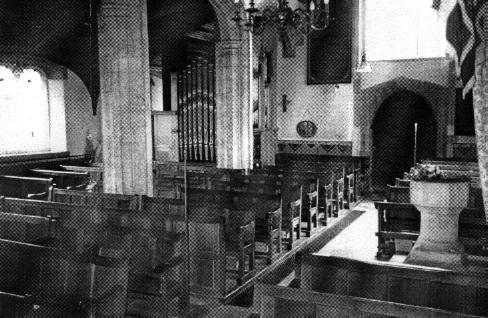
The ORGAN is a two manual pipe organ with pedals, electric blower, and mechanical (tracker) action, made by Bate and Son. It was purchased from the church at Uplyme in 1938, and cleaned and restored in 1997.
The PULPIT, which now occupies the elliptical recess in the wall of the nave, dates from 1935.
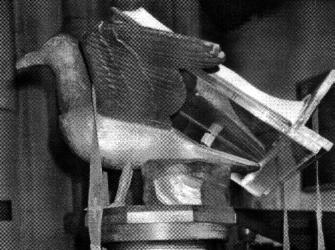
The SEAGULL LECTERN dates from 1969. It was designed by Dr Eric Ennion, and carved by Walter Radcliffe Raymond, of Raymond Bros. Yeovil.
The PAINTING of the Virgin and Child with St. John, St. Francis, and Mary Magdalene, was given in 1969.
The CARPET on the floor of the crossing was made by ladies of the parish in 1981. There is a photograph and information relating to this in the south transept.
Monuments and Memorials
Of the considerable number of monuments and memorial tablets the major ones of historical interest mentioned in the RCHM are:-
| North transept: | Major John Ironsyde 1694, and Katherine wife of John Ironsyde 1705 |
|
| Elizabeth, wife of John Best 1747. | ||
| Crossing: | Gilbert Ironsyde 1678 | |
| Nave - north wall: | Rear Admiral Ingram 1826, Sarah (King) his wife 1810 | |
| Churchyard: | Wall of south aisle - | John Beere 1631 |
| Mary his wife 1612 | ||
| Slab | William Beere 1694. | |
| S. W. of south aisle: | Table tomb | Samuel Beere 1705 |
| N. W. of nave: | Table tomb | William Smith1706, and Dorothy his wife 1695 |
Plate
| Cup and cover, and paten 1573 | Made by Laurence Stratford, Dorchester |
| Paten 1692 | Presented by Rear Admiral Ingram in 1824 |
| Flagon 1778 | |
| Cup 1814 | |
| Chalice and paten (modern) | Given by Canon Dittmer on his retirement in 1964 |
*Some of these items may be seen in the Cathedral Treasury at Salisbury
Registers
The registers begin in 1614.
Controlling Influences
The name Burton Bradstock derives from two sources. Brideton, the town on the Bride, gives us Burton, and the Bradstock part is a reminder that at one time the Rectory and some lands were in the possession of Bradenstoke Priory in Wiltshire.
After the Conquest the Manor was given by the Crown ( Henry 1 ) to St. Stephen's Abbey in Caen. The Rectory had already been given by William 1 to St. Wandrille's Abbey in Normandy, and other lands belonged to Bradenstoke Priory. Frampton Priory near Dorchester (of which there is no trace now) was a cell of St. Stephen's Abbey and sooner or later, by exchange or purchase, this Priory was in possession of most of these aforementioned titles.
During the Wars with France (1337 - 1453 ) and the suppression of alien priories all the property at different times eventually passed to St. Stephen's College, Westminster, founded by Edward 111.
The Manor and Rectory reverted to the Crown at the dissolution of the Colleges during the reign of Edward IV.
Subsequently Elizabeth 1 granted the title to Sir Christopher Hatton. Twenty years later it passed to Sir Thomas Freke, from whom it came to the Pitt- Rivers family. Now, as part of the Bride Valley Team Ministry, the right to appoint the Team Rector is held by the Salisbury Diocesan Board of Patronage.
The Bells of St. Mary's
St Mary's has six bells.
Our two heaviest bells are the oldest and were cast in 1615 and 1616 by the Purdue family at Closworth, which is a small village just into Somerset and not very far from Yeovil. Though repairs were carried out in 1928 and again in 1994 these two bells are still very much as they were originally cast, and have been rung for worship, and on occasions of rejoicing and sorrow, for the best part of 400 years. They weigh 8 cwt. and 10 cwt. respectively, measure approx 3 ft. across the mouth of the bow, and stand about the same high.
The 4th was also made by the Purdues, in 1651, but in a subsequent overhaul it was found to be untunable and had to be recast.
The next to be added was the 2nd, but not until over a hundred years later, in 1762. By then the Closworth foundry was being worked by James Smith, whose name appears on the bell, and Thomas Roskelly. This bell also had to be recast in 1928.
The 3rd was made in 1800 by another famous bell founding family, the Bilbies of Cullompton.
And the final addition was made in 1928 when the treble was cast by Mears & Stainbank, now known as The Whitechapel Bell Foundry Ltd.
| Decalogue | The Ten Commandments |
| Hagioscope | Opening in a wall to allow sight of the main altar from places from which it could not otherwise be seen (sometimes called a squint) |
| Piscina | Embrasure with a drain, for washing communion vessels |
| Reredos | Panelled screen at the back of the altar |
| Rood Screen | Screen across church, usually at entrance to chancel, with a gallery on top for a crucifix and figures St. Mary and St. John. (in the case of Burton Bradstock the loft was fixed directly to the wall between the nave and the crossing) |
| Spandrels | Triangular spaces between an arch and its containing rectangle |
| RCHM | Royal Commission on Historic Monuments - 1952 |
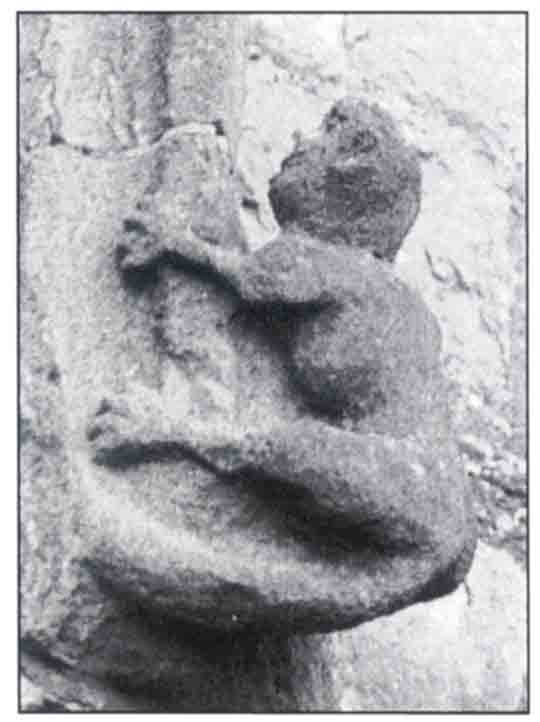
N. wall - external ornamental boss
Text and Photographs © E. Jane Stubbs, Burton Bradstock - 1997 revised 2006 and 2012
From a booklet designed by Richard Dolman, Orpington, Kent.