Rope and Net Making in Burton Bradstock
Men have always used rope for catching and tying up animals and used line for catching fish so it is not possible to ascertain when our village first became involved with producing these items. We know however that the neighbouring town of Bridport was involved prior to May 1213 because King John sent the following message to the Sheriff of Dorset " you cause to be made in Bridport, night and day, as many ropes for ships large and small and as many cables as you can, and twisted yarns for cordage for ballistae" (a device for shooting bolts and javelins)It has been recorded that people in this village started making rope walks in the 16th century and that Bridport objected and petitioned parliament against it. The government thought that it was right that Bridport Industries should be protected if the Navy was to be sure of it's ropes, so in 1530 rope making was banned from being made within a five mile radius of Bridport.
The main ingredients of rope making was of course Hemp and Flax and whilst it was recorded in 1315 that a William Burne was active in the rope industry and that the growing of Hemp and flax was distributed more or less evenly throughout Dorset,records were not available until the end of the 18th Century which showed who grew the crops and where. Prior to this raw material was imported from North America and Riga (Russia) but the War of Independence and the Napoleonic Wars put a stop to this and Parliament had the equivalent of the last wars 'Dig for Victory' and encouraged the growing by passing an Act in 1781 which gave Bounties that encouraged the growing of Hemp and Flax in Dorset. The growers were paid a bounty of 3p per stone for hemp and 4p for flax " dressed ready for market". This act continued for 12 years and following the passing of another Act records were kept which showed the names of growers and the Parish in which they lived and where they grew the crop. An excellent book on this has been produced called Dorset People involved in the Growing of Hemp and Flax 1782-1793 compiled by Diana Trenchard and issued by the Somerset and Dorset Family History Society.
The 1841 census for this village reveals that there were still people involved in the hemp and flax industries. These included Hacklers, Weavers, Flax spinners, Manthia Maker ( maker of veils or making dresses from paper patterns), Flax dressers, Twine netter, Flax corder, Breder of Nets, and 1 Rope maker a William Sponsford of Pound Street. The Mill Owners and manufacturers were Darby and Roberts 1823/4-30; Roberts, Ewens & Co. 1840; Burton Spinning Mills 1875-85 and Rendall & Coombs 1891-1931.
Outworkers
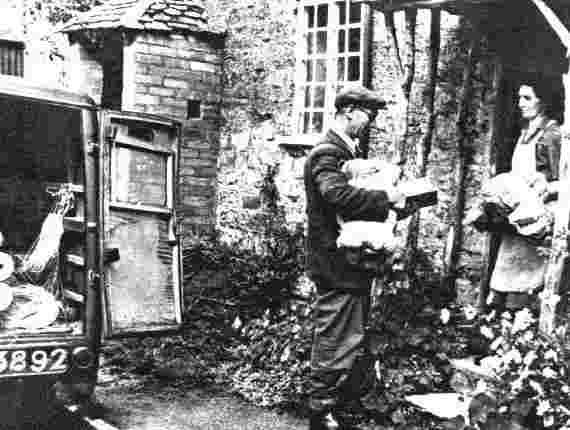
In the book "The Bridport Story" by Gordon Beckles a description is given
which is worth repeating to illustrate an outworker in the Village of Burton
Bradstock. "She might be in her kitchen, or tending the cattle, or helping
in the fields or just sitting before her cottage door, but wherever she might
be she would likely to have near at hand a "ran", or measure, of twine, a block
of wood called a "lace" and a wooden needle shaped like a dagger with a tongue
running down its centre. The needle in her right hand is loaded with the twine,
while from some convenient hook stretches the second strand to the left hand
with which she grips the "lace" - a gauge of the size of net she is making-
and in a flash of a second the first "braider's knot" is tied. Soon the net
begins to shape itself, stretching out further and further from the hook in
a widening pattern of diamond-shaped meshes. She is chatting away to a neighbour
in the next cottage similarly employed, and if there are any children in the
picture, one can be sure that they too are braiding, so that it early becomes
second nature- and not only to the daughters of the cottage but to the sons
as well. There can be scarcely be one man, woman or child who does not know
something of the secrets of net-making"
Mills and Factories in Burton Bradstock
The Domesday Book in the 11th century included Burton Bradstock( Brideton) with five other Royal Manors and together they listed eight mills but it is not possible to ascertain how many if any were actually in this village.
We do know that in in the 1838 factory Returns 3 mills were listed.
Records show the following:- 1814....Richard Roberts produced linen and yarn
1823/4-30 ..Darby and Roberts produced Line, Twine, shoethread and sailcloth.
1840....R.F. Roberts produced Twine,shoethread, flaxtow and yarn
1840....Roberts, Ewens & Co.produced Webs
1840-1944/45 Pymore Mill produced Line, twine, Shoethread,Fishing NetsFlax and
Tow Spinners in Burton Bradstock
1867....Charles Hoare produced Line, Twine, shoethread, nets and flax spinner.
1871....William Vernon produced Line,Nets, Flax spinner.
1875-85...Burton Spinning Mills (James Henry Grant, Manager)
Details of the present mills can be found in "The Roberts' Trail"
Ray West