Historic Notes on Burton Bradstock by Georgie Northover
‘Burton’ derived from ‘Brideton’ - ‘Brith’ or ‘Brid’ (Celtic-to spring forth). ‘Ton’ (Saxon for settlement of people)-village by the spring or river.
Bradstock from Bradenstoke Priory, Wiltshire which acquired land in the parish in 1286.
Pre- recorded history.
Bronze Age burials- Bowl Barrows on Bindbarrow and North Hill, 5,000 year old artefacts found.
Romano-British pottery found at Freshwater.
Romano-British burials found during building of Rosamund Court.
Manor of Burton owned by the Crown at the time of the Conquest in 1066 and in the Domesday Survey it is recorded that there were 8 Mills and 800 sheep.
From the l3th-l7th.centuries the Manor of Brideton (Burton) was a useful asset to both the Crown and Church who bestowed it as a gift or in part exchange in diverse transactions.
Henry I gave it to St. Stephen’s Abbey at Caen in Normandy in order to redeem the regalia of England given to the Monastery by his father, William the Conqueror. Frampton and Bradenstoke Priories (cells of St. Stephen’s Abbey were granted land here, the latter providing the Bradenstoke, later Bradstock, addition to the name).
Edward III, during the Wars of the Roses, suppressed the alien Priories and gave the Manor to St. Stephen’s College, Westminster. Edward VI dissolved the Colleges and grabbed it back for the Crown in the 16th. Century. After that it exchanged hands at regular intervals by sale, gift and inheritance until it was acquired by George Pitt in 1684. It passed to his son, created Baron Rivers, in 1776.
This was the beginning of the long ownership by the Pitt-Rivers family which ended, except for the retention of some farm land and patronage of the Church, with the final sale of the whole of the village (largely to occupying tenants) in 1958 by Capt. G.H.L.F. Pitt-Rivers.
It is interesting to note that the average rent paid by a tenant for a three-bedroom cottage at the time of the sale was £12 per annum. The largest property in the village, The Rookery, was rented by the tenant for £270 per annum - much less than a present day council house!
Controls exercised by the ropemaking industry in Bridport in the early 16th. Century. led to ropewalks being set up in Burton and surrounding villages. To prevent this Bridport secured an Act of Parliament in 1530 forbidding ropemaking or the selling of hemp by anyone living within five miles of the town except at Bridport Market. At the rear of 49, Church Street (Rose Cottage) there is a path which was originally one of the old Burton ropewalks.
The village was rebuilt mainly in the 17th. and 18th. Centuries.
The School. Built in 1865 for 250 children: average attendance (vide Kelly’s Dorsetshire Directory, 1895) was 170. In 1978, with only 56 children attending, it was threatened with closure but was reprieved after strong protests from the villagers.
It is interesting to note in Kelly’s Directory, 1895, that apart from various Shopkeepers, numerous Beer Retailers, Farmers, Fish Merchants etc. there are also listed a ‘Relieving and Vaccination Officer and Registrar of Births and Deaths’ (Darby House), a Tailor, an Income Tax Collector, a Draper and a Shoemaker.
Shadrack Dairy Farm, Mill Street. 16th. Century. Upper part rebuilt, but lower part still has original moulded ceiling beams.
White House. 17th. Century.
Girt House. Queen Anne.
Ingram House. Occupied in the late 18th. Century. by Admiral Ingram (see Memorial Tablet in the Church). He was a close friend of Admiral Sir Thomas Masterman Hardy. In Admiral
Hardy’s letters to Dr. Manfield, one time Mayor of Dorchester, Ingram is frequently mentioned (see notes on Grove House).
The Rookery. Mainly 17th. Century. 16th. Century. plaster ceiling in drawing-room, also Tudor fireplace. Tudor gateway. Rare Ginko tree in the garden. It is considered there was a pre-Tudor habitation here, probably Monastic, but unfortunately all documents relating to the origin The Rookery were destroyed by fire.
Donkey Lane. End cottage (Back o’ November side) was occupied at the turn of the Century. by a fish-wife who drove her donkeys down to Burton Fish Market (see Down Corner notes)- hence Donkey Lane.
Tucked away behind Donkey Lane are two cottages, recently modernised but originally very dark and presumably cold. An early tenant described them as being ‘just like back o’November’. This is now the official postal address!
In 1543 came the return of shipping, the largest in the County of Dorset was the Mary and John-120 tons- owner, Thomas Wade of Burton Bradstock.
Grove House. The home until 1935 of the Roberts family who had strong associations with nelson and particularly with the Battle of Trafalgar. Grove House was acquired in the 18th. Century. by Richard Roberts who married the owner, Mary Hoskins a Farmers s widow.
He was joined there by his brother, Captain Francis Roberts. In 1781 the future Admiral Sir Thomas Masterman Hardy was sent, at the age of 12, to his first ship, the brig ‘Helena’ as Captain’s servant, the Captain being Francis Roberts of Grove House. This was the beginning of a long connection with Admiral Hardy who was a frequent visitor to Grove House where, together with Admiral Ingram of Ingram House there were held many convivial ‘Naval Occasions’ (see “Three Dorset Captains at Trafalgar” by Broadley and Bartelot 1906).
Capt. Roberts’ nephew, Midshipman Roberts, was on board the Victory at Trafalgar and after the battle including the death of Nelson. In his remark book he drew a detailed sketch-plan of the battle. Also among his papers was found, written on a folio sheet of paper bearing the watermark 1801, a copy of the ‘Song of the Loyal Volunteers of Burton Bradstock’, camp song of the Burton Volunteers during the Napoleonic Wars. The author is unknown.
A further link with Nelson was that Cecilia Anna Bennett, who bought Grove House from the last surviving Roberts in 1935,was orphaned as a young child and one of her guardians was Hugh Nelson Ward, a distant cousin, who was the grandson of Horatia Nelson Ward, the daughter of Admiral Nelson.
In 1996 Cecilia’s granddaughter, also Cecilia, was visiting Dorset and found out, purely by chance, that Grove House was up for sale. She had been born in the house in 1947 and had always had a dream of living in it again and was fortunate enough to be able to buy it, so completing the circle.
In her grandmother’s papers she found the following handwritten note:
“Martha Roberts, born 1755, died 1823. She was the only child of .....Hoskins or Hoskyns and had relations at South Perrott, Somersetshire. When Richard Roberts married her she was the widow of Samuel Best of Burtons Farm, whose name is commemorated by a tablet in the north transept of Burton Church.
Richard Roberts, son of Francis Roberts of Bredy by his marriage with Grace Leavers, seems to have been the first owner of Grove freehold property and the flour mill. In 1800 he built the Burton flax mills where sailcloth and ropes were manufactured. Mill now (1936) pulled down, but dated 1800 and initials RR still on stone wall in Mill Lane.
It is believed that Martha owned the Grove property and built the house before she married Richard Roberts. They had 5 children but in spite of that in their later years they did not agree very well and he went to live at a house in the village called ‘Great House’ (Girt House) while his wife lived at Grove. Every morning she sent to enquire how he was and they always saluted each other on Sunday morning after Church.”
(These notes in blue are actually written by Celia Cummins)
Richard Roberts was the first to introduce machinery in the West Country for breaking, swingling and spinning flax and hemp. He produced linens, sailcloth et. from 3 Mills in the village and started the Flax Swingling factory at Grove Mill in 1803. After the decline of the industry Grove Mill was in use as a flour mill and bakery until the 1950’s. The Mill Street factory was burnt down in 1854 and rebuilt by Pitt-Rivers. Burton women were still employed there well into the 20th. Century. The factory chimney was still standing in the 1930’s. Mill Terrace cottages were originally the factory warehouse, the detached house being the foreman’s.
General Notes.
In 1629 records show the number of sailors in Burton was identical as Bridport - 64.
On 9th. March 1881 the Brig ‘Why Not’ was wrecked off the Skerries, Aberdeenshire and Joseph Gear of Darby Lane, Burton and 5 Burton men in the crew were drowned.
From the 18th. to the mid 20th. Century. Gipsies came by pony and cart from Merriott in Somerset to buy fish from Burton Beach, selling them in outlying villages en route back to Merriott.
The story of the origins of the present owners of Woburn Abbey, The Dukes of Bedford is as follows:
In 1506 Philip, Duke of Burgundy and his wife Juana were sailing down the Channel to claim the throne of Castille. A bad storm came and they put into Weymouth. The then Sheriff of Dorset, Sir Thomas Trenchard was aware that King Henry VII had reasons for cultivating friendship with the Duke and hastened to offer hospitality at his house at nearby Wolveton.
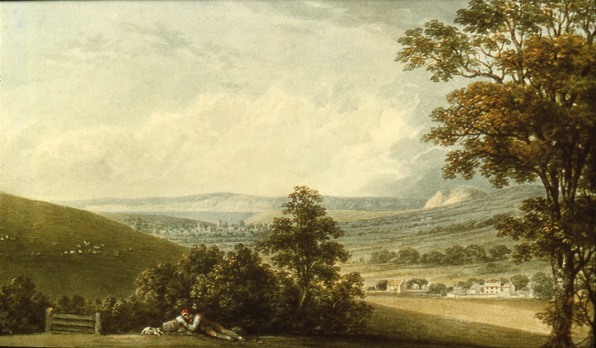
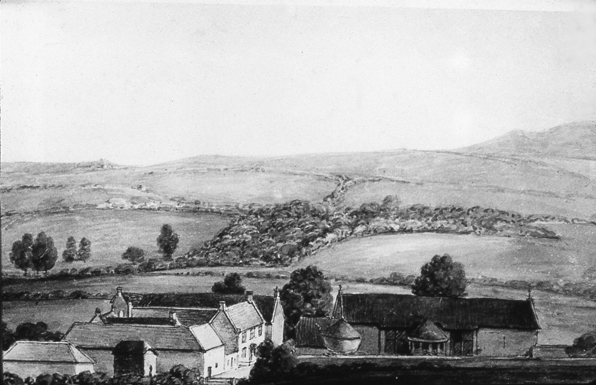
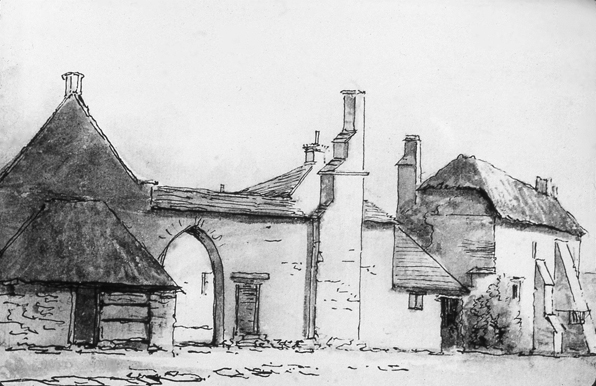
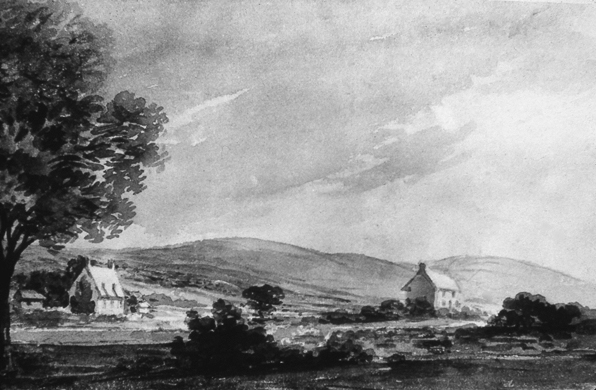
Unfortunately Sir Thomas was no linguist, but remembering his cousin John Russell who ‘had the Spanish’ and was a Squire farming at Berwick Farm (in the Bride Valley), he sent for him to act as interpreter. Farmer Russell impressed the Spanish King so favourably that he took him to London when he went to greet King Henry VII. This also brought the English King’s royal favour to John Russell who, as a result, became the first Earl of Bedford and acquired much of this part of Dorset. Some of the oak wainscoting of the original Kingston Russell House, where Farmer Russell lived, has gone to Woburn Abbey. There are also several pictorial evidences of the Bride Valley at Woburn.
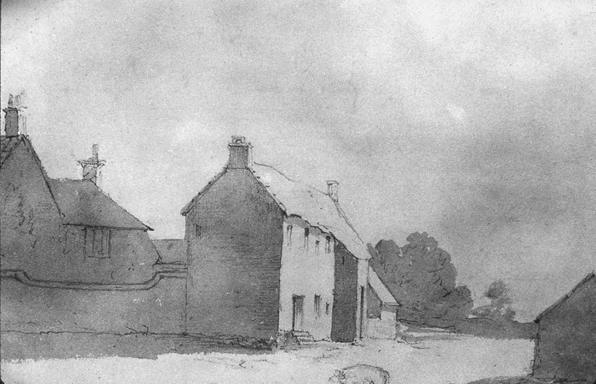
Berwick Farm - old paintings kindly provided by Ivor Bending.
Grove House Mulberry Tree.
Well over 200 years old, mentioned in letters to Captain Roberts from Admiral Sir Thomas Masterman Hardy. Badly damaged by lightning in 1979, but tree surgeons managed to save it.
Property known as the Long Barn (adjoining the river bank on the village side)
This was occupied at the end of the 19th. Century. by the local carrier William Symes who was a local celebrity and would-be dictator, hence the name ‘The Duke’, the bridge over the river being known as’Duke’s Bridge’ (see ‘This Happy England’ a book on Helen Allingham RWS by Marcus B. Huish LLB.) ‘Duke’s Cottage’ was painted by Helen Allingham whose comments on ‘The Duke’ are recorded in the above book.
There is a very fine example of a Spanish wine jug in Weymouth Museum which was taken from the captured Armada ship ‘San Salvador’ in July 1588 by a British sailor from Burton Bradstock named Symes, an ancestor of ‘The Duke’.